Why Financial Transparency Makes or Breaks Business Partnerships
Here is a pattern we see constantly:
Two founders start a company together. Things go well. Revenue grows. But after a few months, one partner starts feeling uneasy. “Am I getting my fair share?” “Is the split still working?” “Where is all the money going?”
These questions are not signs of distrust. They are signs of missing information.
The information asymmetry problem
In most partnerships, one person handles the money. They log into the bank account, update the spreadsheet, and tell the other partner “things look good.”
That is not transparency. That is a report from one person’s perspective.
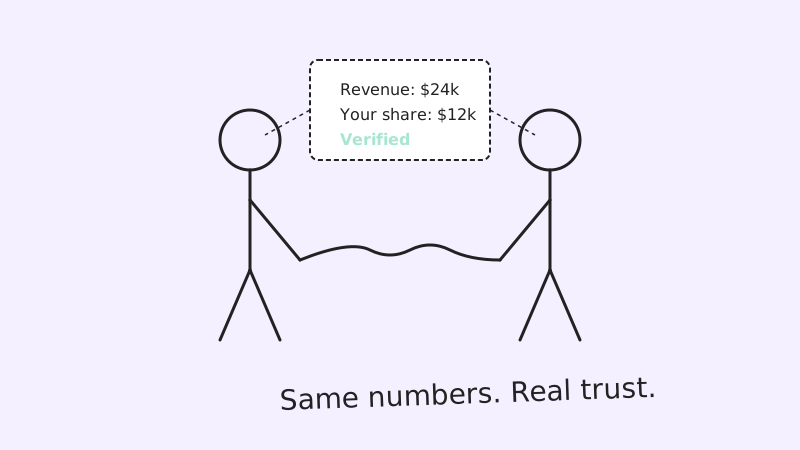
True financial transparency means every partner can independently verify:
- How much revenue came in
- What expenses were incurred
- What the profit is
- How much each person is owed
- When payouts will happen
Without this, even the healthiest partnerships develop friction.
What happens without transparency
Small doubts compound
“I think we made more than that last month” turns into “I do not trust the numbers” turns into “maybe we need to rethink this partnership.”
The spreadsheet becomes a weapon
When one person controls the spreadsheet, it becomes a source of power rather than clarity. Updates get delayed. Formulas get questioned. And eventually, someone hires an accountant just to verify what their partner told them.
Conversations get avoided
When financial conversations are uncomfortable, people stop having them. And when people stop talking about money, misalignment grows.
How to build transparent partner finance
1. Use a shared system, not a shared spreadsheet
A spreadsheet that one person maintains is not “shared.” A system where both partners log in and see the same real-time data is shared.
2. Define the split in writing
Do not rely on verbal agreements. Document who gets what percentage, how it is calculated, and when payouts happen.
3. Make payouts visible
Every partner should be able to see their payout history, pending amounts, and how the numbers were calculated. No black boxes.
4. Review together, monthly
Set a recurring 30-minute meeting to review finances together. Not to audit each other, but to stay aligned.
How RevShared enables transparency
RevShared gives each partner their own login with a scoped view of what they need to see. Revenue, expenses, splits, and payouts are all visible in real time.
No one needs to ask “can you check the spreadsheet?” because everyone can see their own numbers.
Start free and bring transparency to your partnership.